
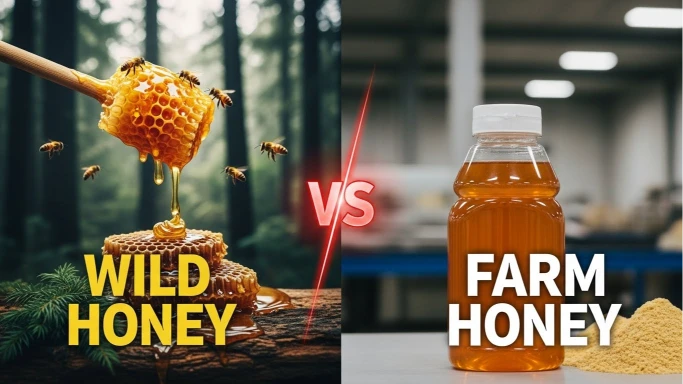
Wild (Jangli) Honey vs Farm Honey
The Truth Without Romanticism
In Pakistan, few words sell honey faster than “jangli”.
Wild honey is often portrayed as purer, stronger, and more medicinal—while farm honey is dismissed as commercial or artificial. This emotional divide has shaped buyer behavior for decades.
But the truth is more complex, and far more important for consumers to understand.
This guide separates biology from belief, process from perception, and reality from romanticism.
What Is Wild (Jangli) Honey?
Wild honey is produced by bees that:
- Build colonies naturally in trees, cliffs, or caves
- Are not managed in boxes
- Harvest nectar from surrounding wild flora
In Pakistan, wild honey is typically collected from:
- Mountain regions
- Forested areas
- Remote valleys
It is usually gathered by cutting combs from natural nests.
What Is Farm (Box) Honey?
Farm honey comes from managed colonies, usually of Apis mellifera, kept in wooden boxes.
This system allows beekeepers to:
- Monitor colony health
- Control harvest timing
- Move hives seasonally
- Prevent over-harvesting
- Maintain consistency
Farm honey is not factory honey.
It is managed natural honey.
A Critical Biological Reality
Here is a fact that changes the entire debate:
The honey-making process is identical in wild and farm bees.
Bees do not know whether they live in:
- A tree hollow
- A cave
- Or a wooden box
They:
- Collect nectar
- Add enzymes
- Reduce moisture
- Seal honey with wax
The difference is not the bee.
The difference is human control over timing and handling.
Why Wild Honey Feels “Stronger”
Many people report that wild honey tastes:
- Darker
- Sharper
- More medicinal
This is usually due to:
- Mixed wild floral sources
- Higher mineral content
- Less filtration
- Seasonal scarcity
However, strength does not automatically mean purity.
Wild honey often varies significantly from batch to batch.
The Hidden Risks of Wild Honey
This is where romanticism hides uncomfortable truths.
Common issues with wild honey:
- Uncontrolled moisture levels
- Fermentation risk
- Inconsistent enzyme activity
- Environmental contamination
- No harvest standard
Because wild honey is collected opportunistically, it is often:
- Harvested before full capping
- Exposed to air and heat
- Stored improperly
Some wild honey is exceptional.
Some is unstable.
There is no systematic quality control.
The Strength of Farm Honey (When Done Right)
Managed beekeeping offers advantages that wild systems cannot.
Farm honey allows:
- Harvest only after full honey maturation
- Moisture control below fermentation thresholds
- Seasonal floral targeting (mono-floral honey)
- Safe extraction without destroying colonies
- Long-term sustainability
This is why export markets rely almost entirely on managed honey, not wild honey.
The Myth: “Box Honey Means Sugar Feeding”
This belief is widespread—and misunderstood.
Reality:
- Sugar feeding is used only during nectar shortages
- It is a survival tool, not a honey substitute
- During nectar flow, bees prefer nectar naturally
Sugar feeding does not define honey quality.
Harvest timing does.
Sustainability: A Conversation Rarely Had
Wild honey collection often involves:
- Cutting entire combs
- Destroying nests
- Killing larvae
- Disrupting ecosystems
Farm beekeeping:
- Preserves colonies
- Allows repeated harvests
- Supports pollination
- Maintains bee populations
Long-term honey supply depends on managed systems, not extraction from nature alone.
Which One Is Healthier?
Health value depends on:
- Enzyme preservation
- Moisture balance
- Clean handling
- Proper storage
These factors are more controllable in farm systems.
Wild honey can be excellent—but it can also be unstable.
There is no automatic winner.
Buyer Mistakes That Cost Quality
Many buyers unknowingly:
- Prefer wild honey only by label
- Ignore fermentation signs
- Reject crystallization
- Trust color over science
Real quality is not visible.
It is structural.
Frequently Asked Questions
Is wild honey always pure?
No. Wild honey can be adulterated after collection, fermented naturally, or contaminated environmentally.
Is farm honey always processed?
No. Farm honey can be raw, unheated, and enzyme-rich if extracted correctly.
Which is better for daily use?
High-quality farm honey is more reliable for daily consumption due to consistency and stability.
Which is rarer?
True wild honey is rarer—but rarity does not equal superiority.
Final Perspective
Wild honey deserves respect.
So does farm honey.
The real enemy is ignorance, not management.
When honey is judged by:
- Science
- Process
- Sustainability
- Transparency
Romantic labels lose their power.
The future of honey lies not in choosing sides, but in choosing standards.