
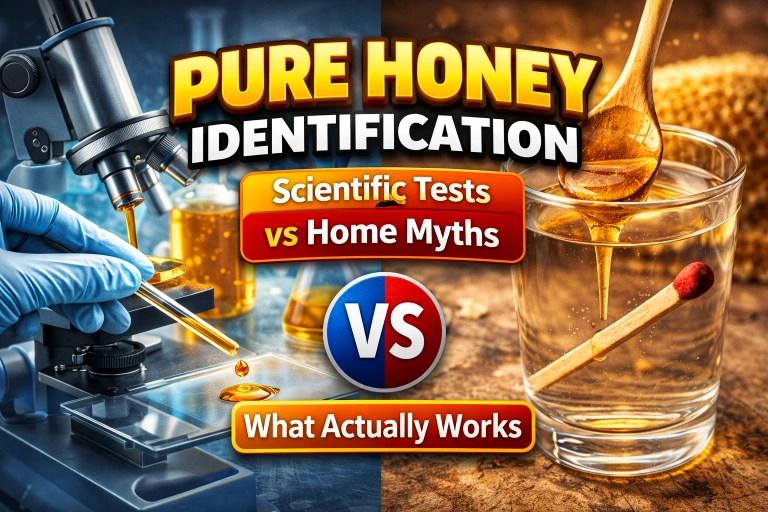
Pure Honey Identification
Scientific Tests vs Home Myths (What Actually Works)
“Paani mein daal ke dekho.”
“Machis jala ke check karo.”
“Cheenti paas aaye gi ya nahi.”
In Pakistan, honey authenticity is judged more by kitchen experiments than by science. Unfortunately, most of these home tests are either incomplete, misleading, or completely wrong.
This guide explains how pure honey is actually identified, what science accepts, what myths fail, and why many fake honeys pass popular home tests with ease.
The Core Problem: Honey Is Chemically Complex
Honey is not a single substance. It is a living natural matrix containing:
- Multiple sugars (glucose, fructose, sucrose)
- Water
- Enzymes
- Organic acids
- Minerals
- Pollen particles
Because of this complexity, no single home test can prove purity.
If someone claims otherwise, they are oversimplifying reality.
Common Home Tests (And Why They Fail)
1. Water Dissolving Test
Claim: Pure honey settles at the bottom of water.
Reality: Viscosity depends on temperature, moisture, and floral source.
Many adulterated honeys:
- Are thicker than raw honey
- Sink similarly
- Pass this test easily
❌ Not reliable
2. Flame / Matchstick Test
Claim: Pure honey burns, fake honey doesn’t.
Reality: Burning depends on surface moisture, not purity.
Even impure honey with low surface moisture can burn.
❌ Dangerous and unreliable
3. Ant (Cheenti) Test
Claim: Ants avoid pure honey.
Reality: Ant behavior depends on:
- Sugar type
- Environment
- Colony needs
Ants often prefer processed sugars but may still ignore real honey temporarily.
❌ Behavioral myth
4. Paper Absorption Test
Claim: Fake honey spreads on paper.
Reality: Absorption depends on:
- Moisture
- Filtration level
- Temperature
Some raw honeys spread.
Some fake honeys don’t.
❌ Inconsistent
Why Fake Honey Passes These Tests
Modern adulteration is not crude.
Fake honey today may include:
- Inverted sugar syrups
- Rice or corn syrups
- Blended sugars mimicking glucose/fructose ratios
These syrups are designed to:
- Look like honey
- Behave like honey
- Fool basic tests
Home tests were never designed to detect industrial adulteration.
What Science Actually Uses to Identify Pure Honey
1. Moisture Content (Refractometer)
- Pure, mature honey: ≤18.5% moisture
- Higher moisture increases fermentation risk
This test alone filters out many unstable honeys.
2. Diastase Activity
Diastase is a natural enzyme in raw honey.
- High diastase = minimal heat
- Low diastase = overheated or old honey
Fake syrups contain no diastase.
3. HMF (Hydroxymethylfurfural)
HMF increases when honey is:
- Overheated
- Old
- Artificially processed
Low HMF = fresh, gently handled honey.
Export-grade honey must meet strict HMF limits.
4. Electrical Conductivity
Used to identify:
- Floral origin
- Mineral content
- Adulteration patterns
Different honeys have distinct conductivity fingerprints.
5. Pollen Analysis (Melissopalynology)
Pollen reveals:
- Flower source
- Geographic origin
- Whether honey is mono-floral or mixed
Ultra-filtered honey fails this test because pollen is removed.
The Most Honest Answer: There Is No Single Test
Pure honey identification relies on multiple indicators, not one trick.
Science looks for patterns, not shortcuts.
Anyone promising a “100% guaranteed home test” is overselling confidence.
Practical Buyer-Level Indicators (What Actually Helps)
While lab tests are definitive, informed buyers can look for signs:
- Seasonal availability (real honey is not uniform year-round)
- Natural crystallization over time
- Flavor complexity (not flat sweetness)
- Source transparency
- Willingness to explain processing
These don’t prove purity—but they reduce risk.
Pakistan Context: Why Confusion Persists
In local markets:
- Education is missing
- Labels are copied
- Tests are misunderstood
- Visual clarity is overvalued
As a result:
- Real honey is doubted
- Fake honey gains confidence
- Buyers lose trust
Ironically, export markets reject honey that passes local myths.
Frequently Asked Questions
Is there any 100% accurate home test?
No. Only laboratory analysis can confirm purity conclusively.
Can fake honey crystallize?
Yes. Some syrups crystallize intentionally to appear natural.
Does thick honey mean pure honey?
No. Thickness depends on moisture and temperature, not purity.
How do exporters test honey?
Using moisture, HMF, diastase, pollen, and sugar profiling.
The Real Truth Most People Avoid
Pure honey is not identified by tricks.
It is identified by process discipline and transparency.
If purity were easy to test at home, adulteration would not exist.
Where Honeeza Draws the Line
Honeeza does not rely on:
- Myths
- Visual tricks
- Fear-based selling
The focus is on:
- Seasonal sourcing
- Controlled extraction
- Raw handling
- Education-first trust
Because real honey does not need drama.