
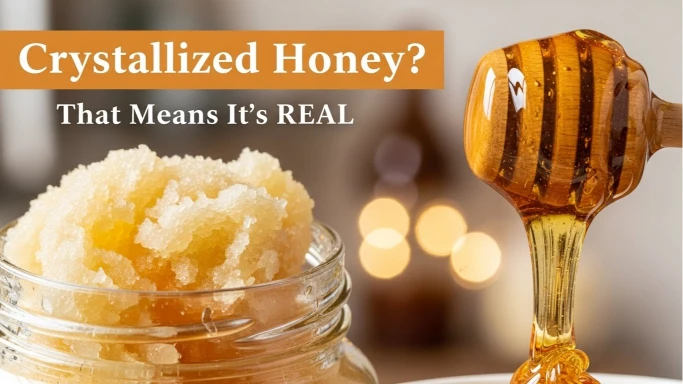
Honey Crystallization – Why Honey Crystallizes (And Why That’s a Good Sign)
One of the fastest ways honey is judged as “fake” in Pakistan is when it crystallizes.
The moment honey turns grainy, thick, or semi-solid, suspicion begins. People assume sugar has been added or the honey has gone bad. In reality, crystallization is one of the strongest indicators that honey is natural and minimally processed.
This article explains why honey crystallizes, what it means scientifically, and why non-crystallizing honey should raise more questions than confidence.
What Is Honey Crystallization?
Crystallization is a natural physical process, not spoilage.
Honey is a supersaturated sugar solution, primarily made of:
- Glucose
- Fructose
- Water
Glucose has lower solubility in water than fructose. Over time, glucose separates and forms crystals, causing honey to thicken or solidify.
Nothing is added.
Nothing is removed.
Nothing is broken.
The Science Behind Crystallization
Two key factors determine crystallization speed:
1. Glucose-to-Fructose Ratio
- Higher glucose → faster crystallization
- Higher fructose → slower crystallization
This ratio is controlled entirely by flower source, not processing.
2. Moisture Content
- Lower moisture → faster crystallization
- Higher moisture → slower crystallization (but higher fermentation risk)
Raw honey typically crystallizes faster because it retains its natural sugar balance.
Why Raw Honey Crystallizes More Often
Raw honey contains:
- Natural pollen
- Tiny wax particles
- Micro air bubbles
These act as crystallization nuclei, giving glucose something to attach to.
Filtered or ultra-processed honey removes these particles, delaying crystallization artificially.
This is why:
The more “perfect” honey looks, the less biologically complete it often is.
Which Honeys Crystallize Faster?
Crystallization speed varies by floral source.
Faster-crystallizing honeys:
- Beri honey
- Mustard honey
- Clover honey
- Sunflower honey
Slower-crystallizing honeys:
- Acacia honey
- Robinia honey
- Citrus honey
This variation is natural and expected.
Common Myths About Crystallized Honey
Myth 1: Crystallized honey is fake
False. Most pure raw honeys crystallize over time.
Myth 2: Crystallization means sugar was added
False. Added sugar syrups often delay crystallization, not cause it.
Myth 3: Crystallized honey is expired
False. Honey does not spoil. Crystallization is reversible and harmless.
Why Non-Crystallizing Honey Deserves Scrutiny
Honey that remains liquid indefinitely may have been:
- Heated excessively
- Ultra-filtered
- Blended for uniformity
These practices:
- Destroy enzymes
- Remove pollen
- Reduce nutritional value
Clear honey is visually attractive, but biology does not prioritize aesthetics.
Can Crystallized Honey Be Used Normally?
Yes. Crystallized honey:
- Retains nutritional value
- Is safe to eat
- Can be consumed as-is
If liquefaction is desired:
- Place the jar in warm water
- Avoid boiling or microwaving
- Keep temperature below ~40°C
Excess heat damages enzymes.
Crystallization vs Fermentation (Important Difference)
Crystallization:
- Thick or grainy texture
- Sweet smell
- No gas bubbles
Fermentation:
- Sour smell
- Foaming or bubbling
- Caused by high moisture content
Crystallized honey is safe.
Fermented honey is compromised.
Pakistan’s Crystallization Problem
Local markets often:
- Reject crystallized honey
- Demand clear honey year-round
- Pressure sellers to heat honey
This leads to:
- Over-processed honey
- Nutritional loss
- Consumer misunderstanding
Ironically, export markets prefer honey that crystallizes naturally.
Why Crystallization Is a Quality Signal
Crystallization indicates:
- Natural sugar structure
- Minimal heat treatment
- Presence of pollen
- Authentic floral source
It is not a defect.
It is a fingerprint.
Frequently Asked Questions
Can crystallized honey turn back to liquid?
Yes. Gentle warming will liquefy crystals without damaging honey if done correctly.
Does crystallization affect taste?
No. Flavor remains intact, sometimes even more pronounced.
Is crystallized honey better for health?
It often retains more enzymes and antioxidants due to minimal processing.
Why does one jar crystallize and another doesn’t?
Different floral sources, moisture levels, and handling methods cause variation.
Final Insight
Crystallization is not honey failing.
It is honey being honest.
When honey behaves like sugar syrup, question it.
When honey behaves like nature, trust it.
Understanding crystallization moves you from buyer confusion to buyer confidence.