
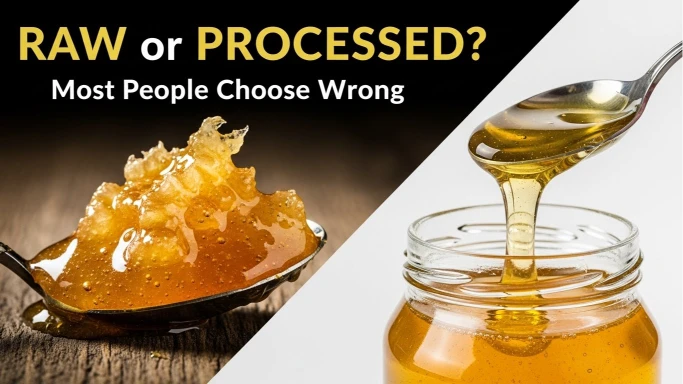
Raw Honey vs Processed Honey
The Complete Truth Most Honey Brands Never Explain
If honey comes from bees, why does all honey not taste, behave, or benefit the same?
This single question exposes one of the biggest misunderstandings in the honey industry. Most consumers believe honey is either “pure” or “fake.” The reality is far more nuanced. Honey exists on a processing spectrum, and where your honey sits on that spectrum determines its nutritional value, enzyme activity, shelf behavior, and even how your body responds to it.
This guide explains the real difference between raw honey and processed honey, using science, beekeeping logic, and Pakistan-specific context. No myths. No marketing shortcuts.
What Is Raw Honey, Scientifically Speaking?
Raw honey is honey that is:
- Extracted from honeycomb using cold or minimal heat
- Not pasteurized
- Not ultra-filtered
- Retains its natural enzymes, pollen, and micro-nutrients
In practical terms, raw honey is honey in its closest edible form to how bees store it.
What raw honey naturally contains
- Enzymes: Diastase, invertase, glucose oxidase
- Natural pollen: Source-specific fingerprint
- Organic acids: Responsible for taste complexity
- Trace minerals: Depending on floral source
- Low moisture balance: Usually below 18.5%
These elements are not “added.” They are destroyed or preserved depending on processing.
What Is Processed Honey?
Processed honey is honey that has been:
- Heated (often above 60–70°C)
- Filtered to remove pollen and fine particles
- Sometimes blended for uniform color and taste
Processing is not always malicious. It is primarily done for:
- Clear appearance
- Longer shelf stability
- Prevention of crystallization
- Easier large-scale distribution
However, processing changes the internal chemistry of honey.
Pasteurization: The Turning Point
Pasteurization is where raw honey becomes processed honey.
What happens during pasteurization?
- Natural enzymes denature
- Pollen is removed or destroyed
- Antibacterial activity drops
- Flavor complexity flattens
- Honey becomes visually attractive but biologically weaker
This is why two honeys can look identical yet behave completely differently in the body.
A Critical Clarification About Sugar Feeding
One of the most common accusations is:
“Bees are fed sugar, so the honey is fake.”
This is partially misunderstood.
When sugar feeding happens
- During extreme cold or drought
- When natural nectar is unavailable
- After honey has been harvested and bees need survival food
What sugar feeding does NOT mean
- It does not automatically enter harvested honey
- It does not replace nectar during active honey flow
- It does not mean adulteration
Bees do not convert sugar syrup into export-grade honey during nectar seasons. Nectar availability, not sugar, determines honey quality.
Raw vs Processed Honey: Side-by-Side Comparison
| Feature | Raw Honey | Processed Honey |
|---|---|---|
| Enzymes | Intact | Reduced or destroyed |
| Pollen | Present | Removed |
| Crystallization | Natural | Delayed or prevented |
| Appearance | Cloudy or textured | Clear and smooth |
| Taste | Complex, floral | Mild, uniform |
| Health use | Preferred | Limited |
| Shelf behavior | Changes over time | Stable |
Crystallization is not spoilage. It is a sign of natural glucose structure.
The Pakistan Context: Why This Difference Matters More Here
Pakistan produces 30,000–35,000 tons of honey annually, yet the majority of export-quality honey never reaches local consumers.
Why?
- Export markets demand mono-floral raw honey
- Local markets prioritize visual clarity
- Consumers associate crystallization with “fake honey”
As a result:
- Pakistan exports raw Beri honey
- Local markets are flooded with over-processed blends
Understanding raw vs processed honey is not academic here. It determines whether you consume world-class honey or industrial sweetener.
Raw Honey and Natural Enzymes: Why the Body Cares
Raw honey contains glucose oxidase, which produces hydrogen peroxide in controlled micro-amounts. This is why raw honey has:
- Antibacterial behavior
- Wound-healing properties
- Cough and throat soothing effects
Once heated, this mechanism weakens.
This is why raw honey is traditionally used in:
- Home remedies
- Herbal formulations
- Unani and Ayurvedic medicine
- Immune support routines
Frequently Asked Questions
Does raw honey expire?
No. Honey does not spoil. Expiry dates on bottles are regulatory labels, not biological reality. Properly stored honey remains edible for decades.
Why does raw honey crystallize?
Because glucose naturally separates from water. This indicates minimal processing, not impurity.
Is processed honey unhealthy?
Not necessarily, but it is nutritionally reduced. It functions more as a sweetener than a therapeutic food.
Can children consume raw honey?
Children above one year of age can consume raw honey in controlled amounts. Infants under one year should not consume any honey.
The Hidden FOMO Most Buyers Miss
If you only consume:
- Clear honey
- Non-crystallizing honey
- Uniformly colored honey
You are likely missing out on:
- Floral-specific benefits
- Natural enzymes
- Authentic taste profiles
Once you understand raw honey, you rarely go back.
Where Honeeza Fits In This Conversation
Honeeza approaches honey the way beekeepers and researchers do:
- Respecting floral seasons
- Preserving raw characteristics
- Avoiding unnecessary heat and filtration
- Educating before selling
Raw honey is not a marketing label. It is a process discipline.
Final Thought
Not all honey is fake.
Not all honey is raw.
And not all processing is evil.
But once you understand the difference, you realize why true honey is rare, seasonal, and valuable.
This knowledge alone changes how you buy, store, and consume honey.